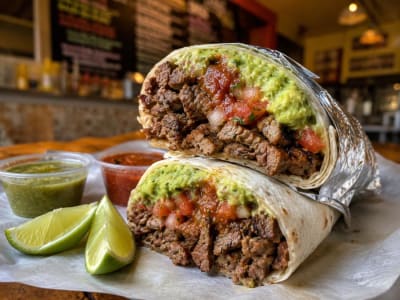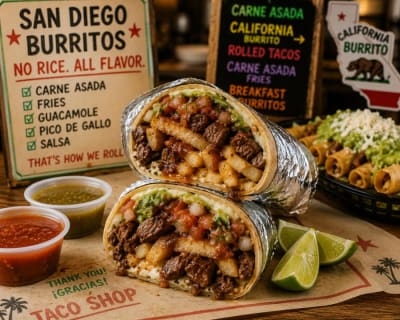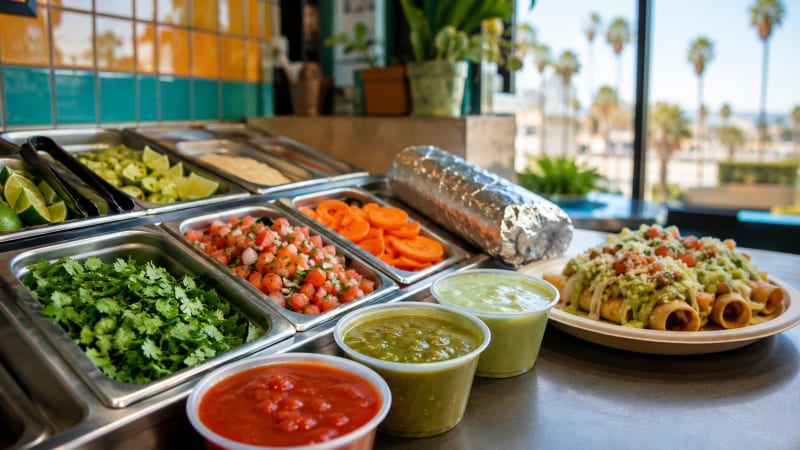
Walk into the right kind of Southern California taco shop and you know exactly where to look after ordering.
Not the soda machine. Not the napkin dispenser. Not the framed menu photos glowing above the counter. You look for the salsa bar.
Sometimes it is a clean stainless-steel station with chilled pans and sneeze guards. Sometimes it is a few squeeze bottles next to a stack of tiny plastic cups. Sometimes it is tucked near the soda fountain, half-hidden behind a mountain of radishes, carrots, limes, and jalapeños. But once you spot it, the ritual begins.
You grab the little cups. You pretend you are only going to take two. Then you take four. Maybe five. Red sauce for the rolled tacos. Green sauce for the carne asada burrito. A smoky roasted one just in case. Something creamy and avocado-colored because it feels necessary. Maybe pico de gallo if the shop offers it. Maybe pickled carrots because you are not a tourist.
The salsa bar is not just a condiment station. In Southern California taco-shop culture, it is part of the meal.
It is also one of those everyday food traditions that feels like it has always existed, even though it had to come from somewhere. Like the California burrito, carne asada fries, or the mysterious spread of “-berto’s” taco shop names across the region, the salsa bar is one of those local institutions that tells a bigger story about immigration, convenience, customization, affordability, and the way Southern California eats.
More Than Hot Sauce
Calling it a “hot sauce bar” is understandable, but it does not quite capture what is happening.
A bottle of hot sauce is usually one thing: heat. A taco shop salsa bar is more like a choose-your-own-flavor map. The sauces are not only about spice. They are about acidity, freshness, smoke, sweetness, texture, and balance.
A thin red sauce might be bright, sharp, and chile-forward. A thicker roasted red salsa might bring charred tomato, dried chile, and a deeper flavor that works perfectly with carne asada. A green salsa may be tomatillo-heavy and tangy, or jalapeño-based and creamy. Some avocado salsas are mild and cooling. Others are sneaky and hotter than they look. Pico de gallo adds freshness. Pickled carrots and jalapeños bring crunch, vinegar, and a little bit of old-school taco shop attitude.
The genius of the salsa bar is that it puts the final step in the customer’s hands. The kitchen makes the burrito, taco, tostada, or rolled tacos. The customer finishes it.
That matters because taco-shop food is personal. One person wants their California burrito flooded with red sauce after every bite. Another wants green salsa inside the wrapper before each fold. Someone else wants three containers of salsa and no explanation. The salsa bar understands this. It does not judge.
The Roots Run Deeper Than the Bar
Salsa itself is much older than the self-serve station at the local taco shop. Long before the modern Southern California salsa bar, people in Mexico and across Mesoamerica were combining chiles, tomatoes, tomatillos, herbs, seeds, and other ingredients into sauces that brought heat and flavor to food.
That tradition did not arrive in Southern California as a novelty. It traveled through families, border communities, home kitchens, street stands, and restaurants. What changed in Southern California was the format.
The salsa bar took something traditional, flexible, and essential, then adapted it to a fast-service restaurant model. It made variety visible. It turned salsa into part of the customer experience. Instead of one house salsa appearing at the table, the customer could choose.
That shift fits Southern California perfectly. This is a region shaped by Mexican food traditions, car culture, beach towns, suburbs, late-night drive-thrus, and quick meals eaten between work, school, surf sessions, errands, and everything else. The salsa bar is efficient, but it still feels generous. It is fast food with personality.
The Taco Shop Ecosystem
To understand the salsa bar, you have to understand the Southern California taco shop.
This is not the same thing as a sit-down Mexican restaurant with chips, salsa, combination plates, and a server refilling your water. The taco shop is usually faster, smaller, brighter, and more direct. You order at the counter. You get a number. You listen for your order. You carry your own tray. You collect your own salsa.
San Diego played a major role in shaping this style of eating. Roberto’s Taco Shop traces its story back to 1964, when Roberto and Dolores Robledo began operating what became one of the city’s defining taco shop brands. Over time, San Diego became full of taco shops serving burritos, rolled tacos, carne asada, adobada, machaca, chorizo, and other fast, filling Mexican and Mexican-American food.
This environment helped make the salsa bar feel natural. If the food was quick, affordable, and customizable, the sauces needed to be the same. The salsa bar let a small restaurant offer variety without slowing down the line. It reduced the need for every customer to ask for special sauce combinations at the counter. It also created a sense of abundance: your meal may have come wrapped in foil, but you still had options.
That is part of the charm. A taco shop salsa bar is democratic. Everyone gets access. The person ordering two tacos gets the same salsa choices as the person ordering a giant burrito, carne asada fries, and three rolled tacos with guacamole. You do not need to know a secret password. You just need to know which sauce goes with what.
The Rise of the Fast-Casual Salsa Bar
By the late 1970s and 1990s, the salsa bar also became part of a broader “fresh Mexican” restaurant movement in California.
La Salsa, which opened its first taqueria in Los Angeles in 1979, built part of its identity around fresh ingredients and a distinctive salsa bar. Baja Fresh, founded in California in 1990, also became known for customizable Mexican food and a self-serve salsa bar. These chains did not invent salsa, and they did not invent the taco shop, but they helped make the salsa bar recognizable to a wider audience.
That matters because the salsa bar sits at an interesting crossroads. In old-school neighborhood taco shops, it feels practical and local. In fast-casual chains, it became part of a brand promise: fresh, colorful, made-your-way food. Both versions helped normalize the idea that salsa should not be limited to one mild red cup handed over with your order.
For many people who grew up in Southern California, the salsa bar was not a special feature. It was expected. A taco shop without one could feel incomplete, like a burger place without fries or a pizza shop without parmesan and crushed red pepper.
The Little Plastic Cup Ritual
The tiny salsa cup deserves its own paragraph.
It is one of the most important objects in taco shop culture. Too small to be practical, too useful to ignore, and somehow always the center of a negotiation between hunger and restraint.
You start with two cups because that seems reasonable. Then you realize one red and one green is not enough. What if the green is mild? What if the red is the better match for the burrito? What if the rolled tacos need their own sauce? What about the carrots? What about the salsa you want for the last few bites?
So you stack a few more.
This is where experience shows. A rookie fills the cups too high and spills salsa all over the tray. A veteran leaves just enough room for the lid. A true local knows that salsa management is part of the meal. You do not dump all of it at once. You portion it out. You test. You adjust. You save one cup for the end.
This little ritual creates a relationship between the customer and the food. The burrito is not finished when it leaves the kitchen. It is finished bite by bite, sauce by sauce.
What Each Salsa Says
Every taco shop has its own salsa personality, but the classics usually fall into a few familiar roles.
Red Salsa
This is often the workhorse. It can be thin and fiery, smoky and roasted, or tomato-heavy and mild. At many San Diego-style taco shops, a thin red sauce is the one people pour over carne asada fries, rolled tacos, breakfast burritos, or anything wrapped in foil at 1 a.m.
Red salsa is usually the safest starting point, but not always the mildest. Some shops hide real heat in the red.
Green Salsa
Green salsa can mean many things. It might be tomatillo-based, bright, acidic, and perfect for tacos. It might be jalapeño-heavy and blended smooth. It might have avocado, giving it a creamy texture and lighter heat.
Green salsa often feels fresher than red salsa, which makes it great with grilled meats, fish tacos, and breakfast burritos. It cuts through grease and adds life to heavy food.
Avocado Salsa
This is the comfort sauce. It is smooth, pale green, and often mild enough to use generously. It is not always true guacamole, and that is fine. Its job is not to be chunky and luxurious. Its job is to cool, coat, and make everything feel richer.
Avocado salsa is especially important for rolled tacos, carne asada burritos, and anything that benefits from a creamy finish.
Pico de Gallo
Pico de gallo is not always part of the salsa bar, but when it is, it brings freshness. Tomato, onion, cilantro, chile, lime, and salt can wake up a heavy plate. It is less sauce and more topping, which makes it useful when you want texture instead of more liquid.
Pickled Carrots and Jalapeños
These are the unofficial test of whether you understand the assignment. The pickled carrot is not decoration. It is a crunchy, spicy, vinegary sidekick. It cuts through rich food and gives you something to snack on between bites.
Some people ignore them. Those people are missing out.
Why the Salsa Bar Feels So Local
A salsa bar is common enough that it may seem ordinary, but in Southern California it carries a lot of local meaning.
It reflects the region’s relationship with Mexican food as everyday food, not special-occasion food. It reflects the influence of border culture, where flavors, techniques, and restaurant formats move naturally through communities. It reflects the taco shop as a neighborhood fixture: affordable, fast, familiar, and open when you need it.
It also reflects Southern California’s love of customization. The same way people customize coffee, burgers, poke bowls, smoothies, and burritos, the salsa bar gives every customer control. But unlike modern app-based customization, the salsa bar feels physical and communal. You stand there with other people. You watch what they choose. You wonder if they know something you do not. You take one of whatever they took.
There is a quiet social code to it. Do not block the station forever. Do not leave a mess. Do not use ten cups if you only need two. Do not pretend you are too good for the pickled carrots. And if you find a salsa that is clearly the best one, remember it for next time.
The Pandemic Changed the Salsa Bar
For a while, the self-serve salsa bar became uncertain. During the COVID era, many restaurants removed shared condiment stations, switched to pre-filled cups, or handed out salsa only upon request. For obvious reasons, the open salsa bar suddenly looked less practical than it once had.
Some places brought it back. Some never fully did. Others changed the setup, using covered containers, staff-filled cups, bottled sauces, or limits on how many salsas come with each order.
That shift made a lot of people realize how much they missed the old ritual. Getting salsa cups in a bag is convenient, but it is not the same. The self-serve salsa bar lets you browse. It lets you be curious. It lets you decide that tonight is a three-salsa night.
The loss, even temporarily, proved that the salsa bar was never just about sauce. It was about participation.
The Salsa Bar as a Trust Signal
A good salsa bar says something about a taco shop.
It says the restaurant expects customers to care about flavor. It says the food is meant to be adjusted and personalized. It says the kitchen has enough pride to offer more than one option. It also says the place understands the way people actually eat.
That does not mean every good taco shop needs ten salsas. Some of the best places may only offer two. But those two need to matter. A great red and a great green can beat a huge lineup of forgettable sauces.
The salsa bar is not about quantity. It is about identity.
A shop’s salsa can become part of its reputation. People remember the place with the smoky red sauce, the creamy green sauce, the dangerous orange sauce, or the carrots that are somehow hotter than expected. Sometimes the salsa is what brings people back as much as the burrito itself.
The Unwritten Pairing Guide
There are no strict rules, but there are strong opinions.
Carne asada burrito? Red or green, depending on the shop. California burrito? Red for heat, green for brightness, avocado salsa for richness. Rolled tacos? Avocado salsa is practically mandatory, with red sauce for backup. Fish tacos? Green salsa, pico, or something bright and acidic. Breakfast burrito? Red sauce if you want it classic, green if you want it fresher, both if you know what you are doing.
Carne asada fries are their own situation. They can handle almost anything: red, green, avocado salsa, pico, jalapeños, and enough sauce to threaten the structural integrity of the container.
The best move is to experiment. A salsa that is perfect on a taco may disappear inside a burrito. A sauce that seems too hot on its own may be exactly right against cheese, meat, fries, and tortilla. The salsa bar rewards trial and error.
Why It Still Matters
The SoCal taco shop salsa bar deserves more credit than it gets.
It is humble, practical, and easy to overlook. But it represents something important about the way food culture develops. It shows how old flavors can adapt to modern restaurant formats without losing their soul. It shows how customers become part of the final dish. It shows how a simple station of sauces, onions, cilantro, carrots, and limes can become a local ritual.
A great salsa bar turns a meal into a small adventure. You order what you know, then season it into something personal. You try the red. You compare the green. You take one more carrot. You tell yourself you finally know your favorite, then the next taco shop changes your mind.
That is the beauty of it.
The salsa bar is not fancy. It is not precious. It does not need a rebrand. It is one of Southern California’s quiet food treasures: a tiny, spicy, plastic-cupped expression of abundance.
And if you grew up around it, you know the truth.
The burrito may be the main event, but the salsa bar is where the meal becomes yours.