Remember When Burritos Cost $3?
How Rising Costs Are Reshaping Taco Shop Culture
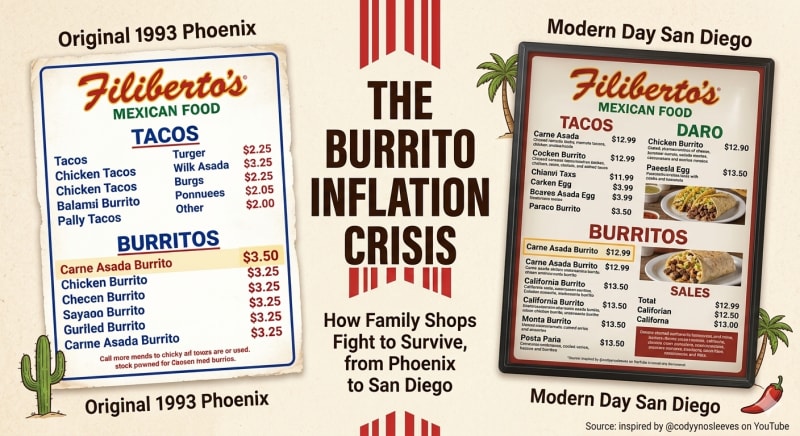
A recent viral video shows a simple, devastating contrast: a 1990s-era menu from Filiberto's Mexican Food in Phoenix, where burritos that once cost around $3 now ring up at $12 to $15. The creator, [@codyynosleeves](https://www.youtube.com/@codyynosleeves/shorts), captured what taco lovers across the country already know: the golden era of the cheap, satisfying burrito is fading into memory.
From Phoenix to San Diego, from Los Angeles to small towns across America, taco shops are facing the same crisis. These aren't corporate chains with deep pockets and pricing algorithms—they're family-owned spots where the person at the register knows your order by heart. And right now, they're all struggling with the same impossible math: how to keep serving authentic food at prices people can afford when every single ingredient, every utility bill, and every employee paycheck costs more than it did just a few years ago.
The Numbers Tell a Painful Story
That Phoenix Filiberto's menu represents a journey most taco shops across America have taken. While the timeline spans decades, recent years have accelerated the pain. Industry data shows tacos experienced nearly a 6% price increase year-over-year in 2024, one of the biggest jumps among handheld favorites. But the real shock comes when you compare specific markets.
In San Diego, a California burrito that cost $7.50 just a few years ago now runs $13 or more. Similar stories echo across California, Arizona, and Texas—the heartland of American taco culture. Fast-food chains like Taco Bell have raised prices 81% over the past decade, far outpacing the 31% overall inflation during that period. Independent shops face the same pressures but without the marketing budgets or economies of scale to absorb them.
The culprit isn't just one thing:
- Beef prices have skyrocketed nationwide, particularly during supply chain disruptions
- Tortillas, cheese, avocados, cilantro—all the staples that make authentic Mexican food—have climbed steadily
- Labor costs are up over 30% at limited-service restaurants in the past four years
- In California, new minimum wage laws for fast-food workers pushed base pay to $20/hour, creating ripple effects across the industry
- Rent, insurance, utilities—every line item on a taco shop's budget has trended in the wrong direction
Behind the Counter: Shop Owners Navigate the Squeeze
The numbers are abstract until you talk to actual shop owners. Ramon Juarez, who runs El Armando's Mexican Food in Poway, California, watched his meat costs double during the pandemic and hasn't seen them return to normal. Like taco shop owners from Phoenix to Los Angeles to Houston, he faced an impossible choice: absorb the costs and watch his margins evaporate, or pass them on to customers who were already stretching their budgets.
During COVID-19, surcharge signs appeared at taco shops across the Southwest—$1.25 added to carne asada items here, 97 cents there. These weren't greedy cash grabs; they were survival measures. The signs explained the reality: "Protein prices are skyrocketing." Most shop owners promised these were temporary. But as anyone ordering tacos today knows, prices haven't gone back down.
Filiberto's itself has grown to over 50 locations across Arizona, with most items now ranging from $9 to $14. The family-owned chain that started in Phoenix in 1993 has maintained its authenticity, but those 1990s prices are long gone. The same story plays out at independently owned shops in every market: costs keep rising, and there's only so much a burrito can cost before customers start looking elsewhere.
What's at Stake: More Than Just Burritos
Taco shops occupy a unique place in American food culture. They're not fast food in the McDonald's sense, but they're not sit-down restaurants either. They're the neighborhood anchor—the place you hit at 2 AM after a concert, where you know the person at the register by name, where your order has been the same perfect combination for years.
In cities with deep Mexican food traditions—San Diego, Phoenix, Los Angeles, San Antonio—these shops are cultural institutions. They've always been democratic: you didn't need a fat wallet to enjoy world-class tacos. A construction worker and a college student could sit at the same counter, both getting an incredible meal for under $10. That accessibility is now under threat.
The competition that once kept prices low is now part of the problem. Markets packed with taco shops meant margins were always thin. Now, with costs rising across the board, there's less room to compete on price. Some shops are:
- Reducing portions slightly
- Trimming their menus, cutting less popular items to focus on what sells
- Cutting 24/7 hours—long a staple in Phoenix and San Diego—as owners optimize hours to reduce labor costs
How Shops Are Adapting
Despite the challenges, taco shop owners across the country are finding creative ways to survive:
Direct Supplier Relationships
Many have negotiated directly with suppliers, cutting out middlemen to control costs.
Strategic Hours
Others have adjusted their hours, closing during slow periods while maintaining service when customers need it most—late nights for the bar crowd, early mornings for construction workers grabbing breakfast.
Menu Innovation
While traditional items remain the backbone, some shops are experimenting with premium options—specialty tacos or burritos with unique ingredients that can command higher prices while delivering something new. The goal is to keep core items affordable enough that regular customers don't feel priced out, while offering higher-margin items for those willing to try something different.
Technology Adoption
More shops are embracing online ordering and delivery apps, expanding their customer base beyond walk-in traffic. Some have launched loyalty programs or taco subscription services. It's a delicate balance: maintaining the authentic, neighborhood feel while adapting to modern business realities.
More Than Just Inflation
The pressure on taco shops reflects broader economic trends hitting Americans across the country. When a burrito that used to cost $3 now costs $12, and wages haven't kept pace with that same trajectory, something has to give. Fast food was supposed to be the affordable option—but when Taco Bell's prices have jumped 81% in a decade, that promise feels broken.
Independent taco shops are caught in the middle. They can't compete with chains on marketing or volume discounts, but they also can't afford to match the quality and authenticity that keeps customers coming back if they slash prices. The shops that survive will be the ones that can communicate their value proposition clearly: yes, you're paying more, but you're getting real carne asada marinated in-house, handmade tortillas, and recipes passed down through generations.
Some markets are hurting more than others. Cities with high costs of living—San Diego, San Francisco, Los Angeles—see the biggest price jumps. But even in more affordable areas, taco shops are feeling the squeeze. The ingredients cost the same whether you're in Phoenix or a small Texas town. The only difference is how much local customers can afford to pay.
What Comes Next
The viral video of that 1990s Filiberto's menu isn't just nostalgia bait. It's a reminder of what we're losing—not just cheap burritos, but the easy accessibility of authentic food culture. When a basic burrito costs as much as a sit-down restaurant entrée, the casual, democratic nature of taco shop culture shifts.
The question isn't whether prices will keep rising—they will. It's whether our beloved taco shops can survive the climb. Some won't make it. We're already seeing longtime spots close their doors across the country, unable to reconcile their commitment to quality and portion size with the new economics of the industry.
But there's reason for hope. Customers who understand why prices are rising—and see their local shops struggling to adapt while maintaining quality—are often willing to pay a bit more. The key is communication: explaining the pressures, sharing the journey, and maintaining the trust that's been built over decades of late-night burritos and early-morning breakfast plates.
Supporting What We Love
The next time you're deciding between your regular taco shop and a cheaper fast-food option, remember what you're really choosing. You're not just buying a burrito. You're:
- Supporting a small business navigating impossible economics
- Preserving a piece of American food culture
- Keeping alive the possibility that future generations might still experience the joy of a perfect 2 AM burrito from their neighborhood spot
That Filiberto's menu from the '90s is gone. But the tradition it represents—authentic, accessible Mexican food served by people who care about their communities—doesn't have to be. Whether you're in San Diego, Phoenix, Los Angeles, or anywhere else lucky enough to have real taco shops, support them. Understand the pressures they're facing. Be patient when prices tick up. Because once these neighborhood institutions are gone, no amount of nostalgia will bring them back.
And America without its taco shops would be a sadder, less delicious place.
---
Additional sources: Toast Restaurant Data, San Diego Union-Tribune, KPBS Public Media, San Diego Voice & Viewpoint, NBC 7 San Diego, U.S. Bureau of Labor Statistics