A San Diego burrito is not just a burrito made in San Diego.
That would be too easy.
A real San Diego burrito has a certain attitude. It is simple, heavy, direct, and built around the good stuff. It does not need rice to take up space. It does not need beans to prove it is a burrito. It does not need to be over-explained.
It needs a warm tortilla, good meat, the right fillings, and a taco shop that understands the assignment.
San Diego burritos are part of the city’s food identity in the same way rolled tacos, carne asada fries, fish tacos, and salsa bars are. They are casual, filling, border-influenced, late-night-friendly, and deeply tied to the local taco shop experience.
So what actually makes a San Diego burrito a San Diego burrito?
Let’s unwrap it.
The First Rule: No Rice as Filler
If there is one thing that separates a San Diego burrito from a lot of burritos across America, it is this:
Rice is not the main event.
In many places, burritos are packed with rice and beans. That style can be great, especially when done well. But San Diego burritos usually take a different approach.
The San Diego style is more focused. Less filler. More feature.
Instead of loading the tortilla with rice, a San Diego burrito usually highlights things like:
- Carne asada
- French fries
- Guacamole
- Sour cream
- Cheese
- Pico de gallo
- Salsa
- Shrimp or other seafood
- Eggs and potatoes for breakfast burritos
That does not mean rice is illegal. Some shops offer it. Some burritos include it. Some people like it.
But if someone is talking about a classic San Diego-style burrito, rice is usually not what they are talking about.
The local mindset is simple: if the burrito is already filled with carne asada, guacamole, fries, cheese, salsa, or potatoes, why pad it out?
A San Diego burrito is not trying to be the biggest burrito possible.
It is trying to be the best bite possible.
Carne Asada Is the Foundation
The carne asada burrito is one of the most important burritos in San Diego.
It is also one of the simplest.
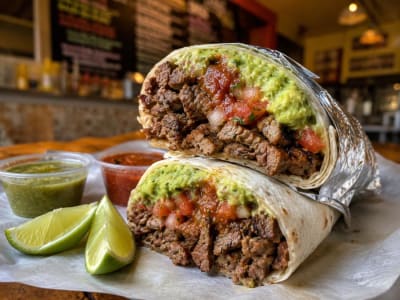
At its best, a carne asada burrito is just a warm flour tortilla filled with grilled steak, guacamole, and pico de gallo. Some shops add salsa. Some add cheese. Some keep it old-school and minimal.
The point is the meat.
The carne asada should be savory, grilled, slightly charred, and chopped into pieces that give the burrito texture. It should taste like it came off a hot grill, not like it was scooped from a steam tray as an afterthought.
A good San Diego carne asada burrito does not need much else because the whole burrito depends on the quality of the steak.
If the carne asada is great, the burrito works.
If the carne asada is bland, no amount of extra toppings can save it.
The California Burrito Changed Everything
If the carne asada burrito is the foundation, the California burrito is the loud younger cousin that became famous.
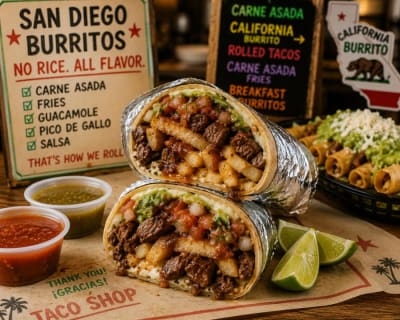
The basic California burrito usually includes:
- Carne asada
- French fries
- Cheese
- Sour cream
- Guacamole or pico, depending on the shop
- A large flour tortilla
The fries are what make it iconic.
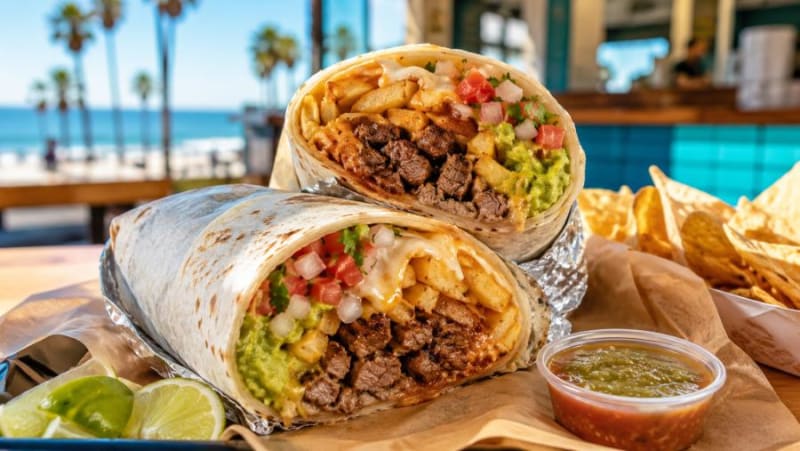
This is where San Diego burrito logic really separates itself from other styles. Instead of rice and beans, the California burrito uses fries as the starch. That gives the burrito a salty, crispy, soft, golden center that pairs perfectly with grilled steak and creamy toppings.
It is not subtle.
It is not light.
It is not pretending to be health food.
It is a San Diego classic because it tastes like something created by people who understood exactly what you would want after the beach, after work, after a night out, or after deciding that a normal burrito was not enough.
The California burrito is one of the clearest examples of what makes San Diego burritos different: it is built for satisfaction, not tradition alone.
The Tortilla Has a Job to Do
A San Diego burrito lives or dies by the tortilla.
The tortilla needs to be large, warm, flexible, and strong enough to hold everything together without turning into a soggy blanket. It should have enough chew to support the fillings, but not so much thickness that it takes over the burrito.
This matters because San Diego burritos are not always gentle.
Carne asada, fries, guacamole, salsa, sour cream, and cheese can put serious pressure on a tortilla. A weak tortilla gives up halfway through the meal. A great tortilla holds the line.
A good tortilla should do three things:
- Wrap tightly
- Stay flexible
- Let the fillings be the star
Nobody orders a burrito because they want a mouthful of tortilla. But without the right tortilla, the whole thing falls apart.
Literally.
Guacamole Is Not Just an Add-On
In San Diego, guacamole is not treated like a luxury upgrade in the same way it is at some national chains.
At a real taco shop, guacamole often feels like part of the language.
It shows up in carne asada burritos, rolled tacos, California burritos, carne asada fries, and combo plates. It adds richness, freshness, and that unmistakable San Diego taco shop flavor.
The guacamole does not always have to be chunky tableside-style guacamole. In many taco shops, it is smoother, thinner, or more sauce-like. That is not a flaw. That is part of the style.
A San Diego burrito does not need guacamole every time.
But when it belongs, it really belongs.
Carne asada without guac can feel unfinished. Rolled tacos without guac feel wrong. A California burrito with fries, steak, and guacamole can feel like the city’s entire food identity wrapped in foil.
Salsa Is Part of the Experience
A San Diego burrito is rarely complete without salsa.
And not just one salsa.
The salsa bar is part of the culture. Red, green, orange, pico, roasted, creamy, spicy, mild, mysterious — every shop has its own personality.
Some people pour salsa into the burrito before every bite. Some unwrap the foil as they go and add salsa in sections. Some use one salsa for the first half and another for the second half like they are conducting field research.
The salsa choice changes the burrito.
Red salsa can add heat and depth. Green salsa can bring brightness and tang. Orange salsa can bring creamy fire. Pico can add freshness. Pickled carrots and jalapeños can turn a good order into a full experience.
The burrito is the main event, but salsa is the supporting cast that can steal the scene.
San Diego Burritos Are Taco Shop Food
This might be the most important part.
A San Diego burrito is not just defined by ingredients. It is defined by where and how it is eaten.
It comes from taco shop culture.
That means:
- Big menu boards
- Numbered combos
- Salsa bars
- Styrofoam cups of horchata
- Orange and green sauces
- Rolled tacos with guac
- Carne asada fries
- Breakfast burritos
- Drive-thru windows
- Late-night orders
- Foil-wrapped burritos that feel heavier than expected
The burrito is part of a whole ecosystem.
You can make a San Diego-style burrito anywhere, but the feeling comes from the taco shop experience: fast, casual, filling, and built around cravings.
It is food that works at noon, midnight, after surfing, after work, after a Padres game, or after moving away from San Diego and realizing nobody near you understands what “no rice” means.
San Diego vs. Mission-Style Burritos
To understand the San Diego burrito, it helps to compare it with the Mission-style burrito from San Francisco.
Mission-style burritos are often large and packed with rice, beans, meat, salsa, sour cream, cheese, and other fillings. They are full meals wrapped in a tortilla, and they have their own loyal following.
San Diego burritos usually take a leaner, more taco-shop-focused approach.
Not smaller, necessarily.
Just more direct.
A San Diego carne asada burrito may only have meat, guacamole, and pico. A California burrito swaps rice and beans for fries. A breakfast burrito may be built around eggs, potatoes, cheese, bacon, ham, sausage, or chorizo.
The difference is not about which one is better.
It is about philosophy.
Mission-style burritos are often about abundance and variety inside one wrap.
San Diego burritos are about impact, texture, and the right few ingredients doing their job.
The Core San Diego Burrito Family
If you are trying to understand San Diego burritos, start with these.
Carne Asada Burrito
The classic. Grilled steak, guacamole, pico de gallo, and a flour tortilla. Simple, direct, and dependent on good carne asada.
California Burrito
The icon. Carne asada, fries, cheese, sour cream, and sometimes guacamole or pico. Heavy, salty, creamy, and unmistakably San Diego.
Surf & Turf Burrito
The upgrade. Usually carne asada plus shrimp, often with fries, rice, sauce, pico, or guacamole depending on the shop. Richer and more indulgent.
Breakfast Burrito
The morning hero. Eggs, potatoes, cheese, and bacon, ham, sausage, or chorizo. Sometimes salsa inside. Always better with salsa on the side.
Bean and Cheese Burrito
The simple comfort order. Not flashy, but deeply important. A good bean and cheese burrito tells you a lot about a taco shop.
How to Order Like a Local
The easiest way to sound like you know what you are doing is to keep it simple.
Try:
“Carne asada burrito with guac and pico.”
Or:
“California burrito, add guac.”
Or:
“Breakfast burrito with bacon, potatoes, eggs, and cheese.”
Or:
“Can I get red and green salsa on the side?”
What should you avoid?
Do not assume rice comes in everything. Do not expect every burrito to be Mission-style. Do not call a California burrito “a steak and fry wrap.” Do not underestimate how much salsa you need. Do not be shocked when the burrito is mostly meat, fries, and guac.
That is the point.
What Makes It Authentic?
Authentic can be a tricky word.
Food changes. Regions adapt. Taco shops experiment. Every neighborhood has its favorites. Every local has an opinion. Every person who moved away from San Diego has at least one burrito they still think about.
But a San Diego-style burrito usually feels authentic when it gets the basics right:
- Warm flour tortilla
- Quality carne asada or proper filling
- No unnecessary filler
- Guacamole when it belongs
- Fries in a California burrito
- Strong salsa options
- Built like taco shop food, not fast-casual assembly-line food
It should feel satisfying, casual, and specific.
A San Diego burrito should not taste like it was designed by a committee.
It should taste like it came from a taco shop that has made the same order thousands of times and still knows exactly why people keep coming back.
Final Bite
A San Diego burrito is not defined by one single ingredient.
It is defined by a style.
It is the carne asada burrito that trusts the steak. The California burrito that replaces rice with fries. The breakfast burrito that understands potatoes. The salsa bar that turns every bite into a decision. The foil wrap. The late-night craving. The beach-town practicality. The border influence. The taco shop confidence.
That is what makes a San Diego burrito a San Diego burrito.
No filler. No fuss.
Just a tortilla wrapped around the good stuff. ```