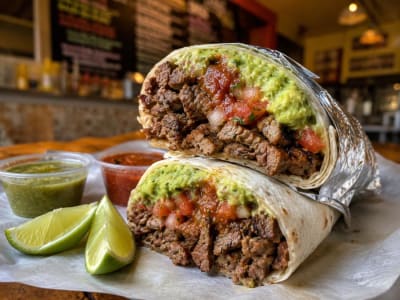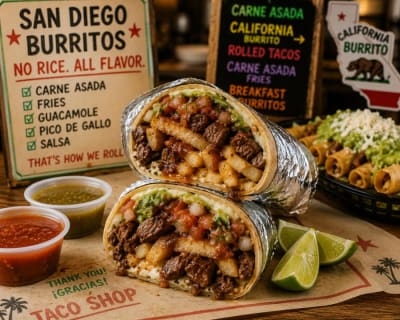
A San Diego taco shop order is not finished when the food hits the tray.
That is only phase one.
Phase two happens at the salsa bar.
This is where the real decisions begin.
Red or green? Mild or hot? Orange sauce or mystery fire? Pico or no pico? How many salsa cups is too many salsa cups? And why do the pickled carrots somehow taste better at 11 p.m.?
The salsa bar is one of the most important parts of San Diego taco shop culture. It is not just a condiment station. It is where you customize the meal, fix a dry bite, add heat, add brightness, and prove that you know the difference between “a little salsa” and “proper preparation.”
Because in San Diego, salsa is not optional.
It is part of the order.
The Salsa Bar Is Part of the Taco Shop Experience
A San Diego taco shop can have great burritos, great rolled tacos, great carne asada fries, and great breakfast burritos.
But if the salsa situation is weak, something feels off.
The salsa bar gives the meal personality. It lets you decide how each bite should taste. It turns a California burrito from heavy to balanced. It wakes up a breakfast burrito. It saves the bottom layer of carne asada fries. It makes rolled tacos feel complete.
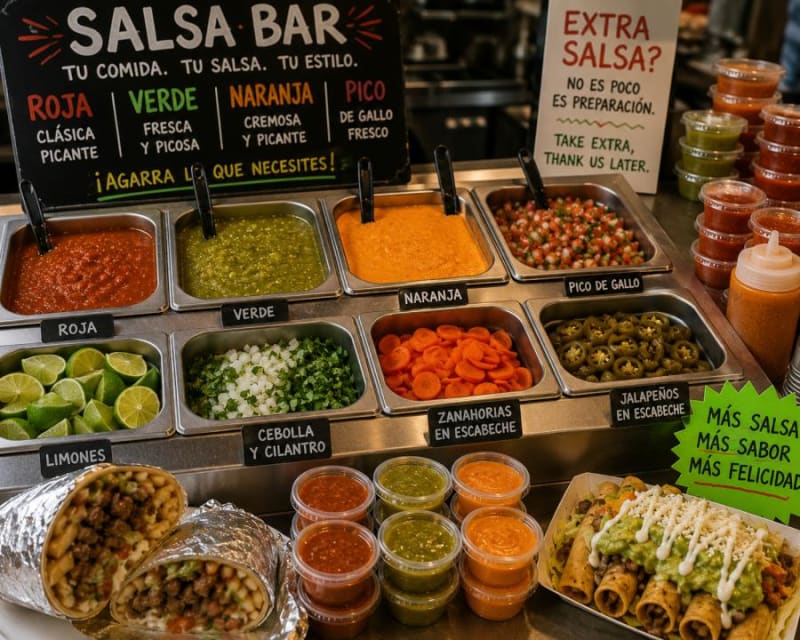
A good salsa bar usually has some combination of:
- Red salsa
- Green salsa
- Orange salsa
- Pico de gallo
- Pickled carrots
- Pickled jalapeños
- Lime wedges
- Sometimes onions and cilantro
- Sometimes roasted salsa
- Sometimes a creamy house sauce
Not every taco shop has a full salsa bar anymore. Some hand out salsa cups from behind the counter. Some package them to-go. Some keep it simple.
That is fine.
The point is not the physical bar.
The point is that salsa matters.
Red Salsa: The Classic Heat
Red salsa is usually the first thing people reach for.
It can be smoky, spicy, roasted, tomato-forward, chile-forward, thin, thick, mild, or dangerous. Every taco shop has its own version, and that version tells you a lot about the place.
Red salsa usually pairs well with:
- Carne asada burritos
- California burritos
- Carne asada fries
- Rolled tacos
- Carnitas
- Birria
- Bean and cheese burritos
- Breakfast burritos
Red salsa is often the best choice when you want heat and depth. It can cut through rich fillings like cheese, sour cream, guacamole, fries, and carne asada.
A good red salsa does not just burn.
It adds flavor.
That is the difference between salsa that makes food better and salsa that just hurts your feelings.
Green Salsa: The Bright One
Green salsa is usually brighter, tangier, and fresher than red salsa.
It often brings tomatillo flavor, chile heat, acidity, and a cleaner finish. It is especially good when the food is rich, heavy, or fried.
Green salsa usually pairs well with:
- Fish tacos
- Carnitas tacos
- Pollo asado
- Breakfast burritos
- Shrimp tacos
- Adobada
- Carne asada burritos
- Rolled tacos
- Quesadillas
Green salsa is the move when you want brightness.
It cuts through fat. It wakes up potatoes. It makes fried fish taste fresher. It keeps a heavy burrito from becoming too much.
If red salsa is the classic heat, green salsa is the reset button.
Orange Salsa: The Cult Favorite
Orange salsa is where things get serious.
Not every taco shop has it. But when they do, people notice.
Orange salsa is often creamy, spicy, and slightly mysterious. It may be made with chiles, oil, garlic, or other ingredients blended into a smooth sauce. The exact style varies by shop, but the effect is usually the same: rich heat.
Orange salsa can be incredible on:
- California burritos
- Carne asada fries
- Carne asada tacos
- Adobada tacos
- Quesadillas
- Breakfast burritos
- Rolled tacos
It is not always the hottest salsa, but it often feels the most addictive.
Orange salsa has a way of making people loyal to a taco shop. You may forget the name of the street, the exact price, or what else was on the menu, but you remember the orange sauce.
That is power.
Pico de Gallo: The Freshness Factor
Pico de gallo is not technically the same thing as a smooth salsa, but at a taco shop it plays a similar role.
It brings freshness, crunch, acidity, and balance.
Pico usually includes tomato, onion, cilantro, chile, lime, and salt. It works especially well when the main order is heavy or meat-focused.
Pico pairs well with:
- Carne asada burritos
- Carne asada tacos
- Fish tacos
- Shrimp tacos
- Pollo asado
- Breakfast burritos
- Quesadillas
- Surf and turf burritos
Pico is not usually about heat.
It is about freshness.
It makes carne asada taste cleaner. It makes shrimp tacos brighter. It makes a burrito feel less dense.
If your food tastes heavy but not spicy enough, pico plus salsa is often the answer.
Pickled Carrots and Jalapeños Deserve Respect
The pickled carrots and jalapeños are not decoration.
They are part of the ritual.
A good pickled carrot is tangy, spicy, slightly sweet, and still firm enough to bite. A good pickled jalapeño brings heat, acidity, and crunch.
They work especially well with:
- Carne asada burritos
- Bean and cheese burritos
- Rolled tacos
- Breakfast burritos
- Combo plates
- Carne asada fries
- Quesadillas
Pickled carrots are the thing people think they do not need until they are standing at the salsa bar grabbing more.
They cut through rich food. They add crunch. They make a simple bean and cheese burrito feel like a full experience.
They also make the bag smell like a real taco shop.
That matters.
How Much Salsa Should You Take?
This is a practical question.
The answer depends on what you ordered.
For one burrito, two salsa cups is the minimum. Three is safer. Four is not unreasonable if you know what you are doing.
For carne asada fries, you probably need at least three.
For rolled tacos, two can work, but more is better if you are sharing.
For a big group order, take more than you think. Someone will always use more salsa than expected. Someone will always decide they want green after saying red was enough. Someone will always drop a cup.
The only real rule is this:
Do not take twenty salsa cups if you are ordering one taco.
Respect the salsa bar.
But also do not underprepare.
A dry burrito halfway through is a preventable tragedy.
Salsa Strategy for Burritos
Burritos require technique.
You can handle salsa a few ways.
The Bite-by-Bite Method
Unwrap a little foil, take a bite, pour salsa on the exposed section, repeat.
This is probably the safest method. It keeps the burrito from getting soggy and lets you adjust as you go.
The Full Pour
Open the burrito, pour salsa inside, close it back up, and commit.
This can be great if you know the salsa and trust the burrito structure. It can also go wrong quickly if the salsa is thin or the tortilla is weak.
The Dipping Method
Pour salsa into a cup or tray area and dip each bite.
This is cleaner in theory, messier in practice, but still valid.
The Alternating Salsa Method
Red for one bite. Green for the next. Orange for the next.
This is for people who understand that a burrito can be a journey.
Salsa Strategy for Carne Asada Fries
Carne asada fries need salsa, but timing matters.
If you pour all the salsa on immediately, the fries may get soggy faster.
If you wait too long, the top bites may be great and the bottom fries may be plain.
The best strategy is usually controlled application.
Add salsa in sections. Work your way through the tray. Make sure every layer gets some attention.
The perfect carne asada fries bite should have:
- A fry
- Carne asada
- Cheese
- Guacamole
- Sour cream
- Salsa
- Maybe pico
- Maybe jalapeño
That is not easy to achieve by accident.
You have to participate.
Salsa Strategy for Rolled Tacos
Rolled tacos are built for salsa.
The crunch, guacamole, and shredded cheese all need heat and brightness.
Red salsa is a classic choice. Green salsa also works well. Orange salsa can be incredible if the shop has it.
The best approach is to salsa each rolled taco individually.
Do not drown the whole plate too early unless you like soggy rolled tacos. The first few bites should still crunch.
A rolled taco should be crispy, creamy, cheesy, and spicy.
That is the goal.
Salsa Strategy for Breakfast Burritos
Breakfast burritos may need salsa more than anything else on the menu.
Eggs, potatoes, cheese, and meat are delicious, but they can get heavy. Salsa wakes them up.
Red salsa works well with bacon, sausage, carne asada, and chorizo.
Green salsa works well with potatoes, eggs, pollo asado, and lighter breakfast burritos.
Orange salsa can turn a breakfast burrito into something addictive.
For breakfast burritos, bite-by-bite is usually best. It keeps the tortilla from getting wet and lets you adjust based on the filling.
Also, always get extra salsa.
Potatoes absorb more than you think.
Mild Does Not Mean Boring
Not every salsa needs to be hot.
A mild salsa can still be excellent if it has flavor.
Some of the best salsas are more about roast, smoke, garlic, tomatillo, lime, cilantro, or tomato than pure heat.
Heat is fun, but flavor matters more.
A salsa that tastes good on its own will usually make the food better. A salsa that only burns may be exciting for five seconds and then annoying for the rest of the meal.
Do not judge salsa only by how spicy it is.
Judge it by whether you keep reaching for it.
The Salsa Bar Tells You About the Shop
A good salsa bar is a sign that the taco shop cares.
It does not have to be fancy. It just has to be useful.
Good signs:
- Salsas taste distinct from each other
- Cups and lids are available
- The salsa is fresh
- Heat levels are clear enough
- Pickled carrots and jalapeños are stocked
- The green salsa is not watery
- The red salsa has flavor
- The orange salsa has personality
- Staff do not act annoyed when you ask for salsa
Bad signs:
- One bland salsa
- Tiny sealed packets
- Empty containers
- Watery pico
- No heat
- No flavor
- No salsa given with a burrito
- A place that treats salsa like an inconvenience
The salsa does not have to be perfect.
But it should matter.
What to Try First at a New Taco Shop
When testing a new taco shop, try both red and green salsa.
Use them on something simple, like a carne asada taco, bean and cheese burrito, or breakfast burrito.
That tells you a lot.
If the red salsa has depth and the green salsa has brightness, you may be in good shape.
If the orange salsa is great, pay attention. That could be the reason people keep coming back.
If the salsa is weak but the food is strong, the shop can still be useful.
If both food and salsa are weak, keep moving.
Life is too short for bad salsa.
Final Bite
The San Diego salsa bar is more than a row of plastic containers.
It is part of the meal.
It is how you finish a burrito. It is how you wake up carne asada fries. It is how you bring rolled tacos to life. It is how you save a breakfast burrito from being too heavy. It is how you decide whether a taco shop really understands what it is doing.
Red brings heat. Green brings brightness. Orange brings obsession. Pico brings freshness. Pickled carrots and jalapeños bring the crunch.
A good taco shop gives you the food.
A great salsa bar lets you make it yours. ```