There are few faster ways to start a burrito argument than saying this:
San Diego burritos don’t need rice.
Some people will agree immediately.
Some people will get defensive.
Some people will start explaining Mission-style burritos, beans, texture, balance, and how rice “helps hold everything together.”
That is fine.
This is not an attack on rice. Rice has its place. Rice can be great. Rice belongs in plenty of burritos, plates, bowls, and family recipes.
But in a San Diego taco shop burrito?
Usually, no thanks.
San Diego burritos have their own logic. They are built around meat, fries, guacamole, salsa, cheese, potatoes, eggs, shrimp, and the kind of tortilla that can hold a serious order without falling apart.
Rice is not the point.
And once you understand the San Diego burrito mindset, skipping the rice makes perfect sense.
This Is a Style, Not a Law
Let’s get this out of the way first.
Not every burrito in San Diego is rice-free. Some shops use rice. Some burritos include rice. Some people like rice in their burritos. Some surf and turf burritos, shrimp burritos, and combo-style burritos can work well with rice.
That is all allowed.
The point is not that rice can never appear.
The point is that the classic San Diego taco shop burrito does not depend on rice the way many other burrito styles do.
A San Diego-style carne asada burrito is often built around:
- Carne asada
- Guacamole
- Pico de gallo
- Salsa
- Flour tortilla
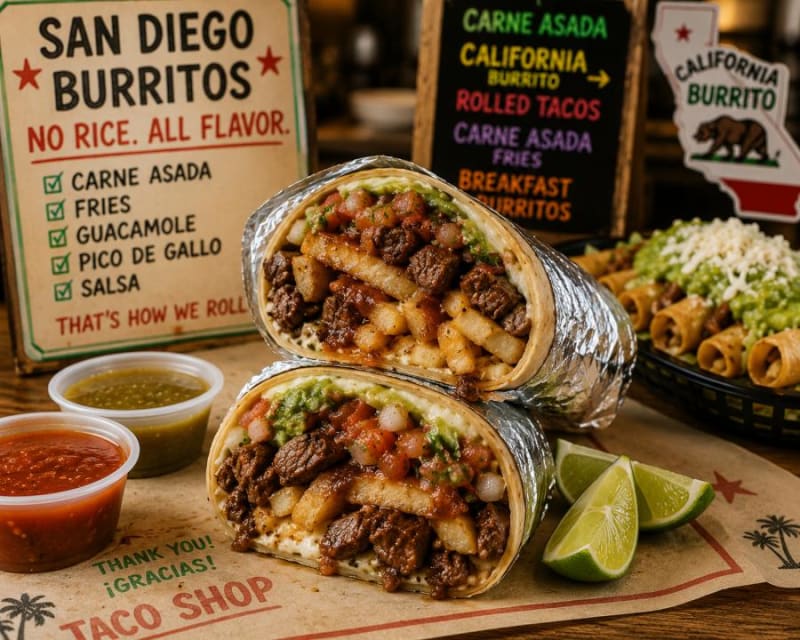
A California burrito is usually built around:
- Carne asada
- French fries
- Cheese
- Sour cream
- Guacamole or pico
- Flour tortilla
A breakfast burrito is often built around:
- Eggs
- Potatoes
- Cheese
- Bacon, sausage, chorizo, ham, or carne asada
- Salsa
Notice the pattern.
The starch is already doing something else.
It might be fries. It might be potatoes. It might be the tortilla itself.
Rice is not needed just to make the burrito feel complete.
San Diego Burritos Are About the Main Ingredient
The San Diego burrito philosophy is simple:
Let the main ingredient lead.
If it is a carne asada burrito, the carne asada should be the star.
If it is a California burrito, the carne asada and fries should be the point.
If it is a breakfast burrito, the eggs, potatoes, cheese, and meat should carry the order.
Rice can sometimes get in the way of that.
It adds bulk, but not always impact. It can soften the texture, absorb salsa, and make the burrito feel bigger without making it better.
A San Diego taco shop burrito does not need to prove its value by being stuffed with filler.
It needs to taste good bite after bite.
That is the difference.
The Carne Asada Burrito Is the Best Example
The carne asada burrito is where the no-rice argument makes the most sense.
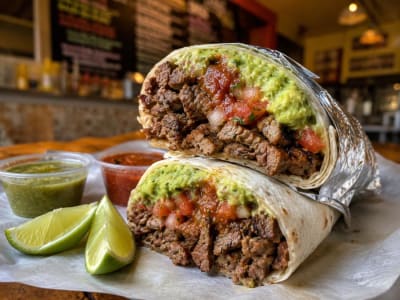
A classic San Diego carne asada burrito is direct. Warm flour tortilla, grilled steak, guacamole, pico, maybe salsa. That is it.
When the carne asada is good, this is enough.
The steak brings flavor and texture. The guacamole adds richness. The pico adds freshness. The salsa adds heat. The tortilla holds it all together.
Rice would not improve that formula.
It would stretch it.
There is a difference.
A great carne asada burrito should taste like carne asada. It should not taste like rice with occasional steak.
That is why San Diego locals get suspicious when a carne asada burrito shows up packed with rice and beans by default.
It may still be a good burrito.
But it is not the San Diego version people are craving.
The California Burrito Already Solved the Starch Problem
If someone says a burrito needs rice for texture or fullness, San Diego has a very simple response:
Fries.
The California burrito is the strongest evidence that rice is not required.
The fries do everything rice is supposed to do, but with more personality.
They add:
- Salt
- Texture
- Weight
- Potato flavor
- A crispy-soft bite
- Late-night credibility
Rice makes a burrito fuller.
Fries make a burrito more San Diego.
That is why the California burrito works so well. It replaces the standard rice-and-bean structure with something more indulgent and more specific.
Carne asada plus fries plus cheese plus sour cream plus guacamole is not trying to be a balanced grain bowl.
It is trying to be a California burrito.
And it succeeds because it knows exactly what it is.
Rice Can Make the Burrito Feel Generic
This is the real issue.
Rice is not bad.
But rice can make a burrito feel like every other burrito.
San Diego burritos stand out because they are more focused. They do not always follow the “rice, beans, meat, salsa, cheese, sour cream, lettuce” formula that shows up across the country.
That formula can be delicious, especially in Mission-style burritos and other regional styles.
But San Diego taco shop burritos have a different identity.
They are often simpler, heavier, meatier, fry-filled, salsa-driven, and less padded.
When rice gets added automatically, the burrito can lose some of that local character.
It starts to feel less like a San Diego taco shop burrito and more like a general-purpose burrito that could have come from anywhere.
That matters when you are chasing a specific craving.
The Mission-Style Burrito Comparison
The rice debate often comes down to regional burrito styles.
Mission-style burritos, strongly associated with San Francisco’s Mission District, are often large and packed with rice, beans, meat, salsa, cheese, sour cream, and other fillings.
That style has its own logic.
Rice and beans help create a full, layered, complete meal inside the tortilla. The burrito is about abundance and structure. It is designed to be big, filling, and varied.
San Diego burritos are different.
They usually feel more taco-shop focused. A carne asada burrito may be just steak, guacamole, and pico. A California burrito uses fries. A breakfast burrito uses potatoes. A surf and turf burrito might use rice sometimes, but it depends on the build.
The difference is not about which city is better.
It is about what each burrito is trying to do.
Mission-style burritos use rice as part of the architecture.
San Diego burritos often skip rice because the architecture is built differently.
Beans Are Part of the Same Debate
Rice usually brings beans into the conversation.
Some people think burritos need both. San Diego does not always agree.
A bean and cheese burrito is a classic. Beans absolutely belong there. Beans also work in some combo burritos, plates, and simple comfort orders.
But in a carne asada burrito or California burrito, beans are not automatically required.
San Diego taco shop burritos often keep the filling focused. If the burrito is about steak, let it be about steak. If it is about fries and carne asada, do not bury that under beans unless you specifically want that style.
Again, this is not anti-bean.
This is anti-filler-by-default.
There is a difference.
Salsa Does More Work Without Rice
One of the best things about a rice-free San Diego burrito is how much the salsa matters.
When a burrito is packed with rice, the salsa often gets absorbed. That can be good in some styles, but it can also dull the heat and brightness.
In a San Diego carne asada burrito, salsa hits more directly.
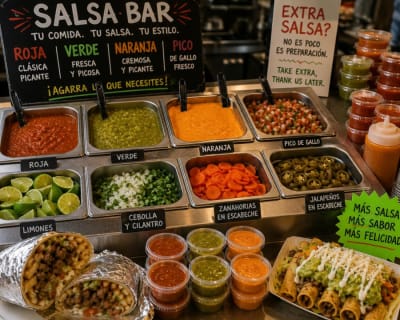
Red salsa cuts through the steak and guacamole. Green salsa brightens the whole bite. Orange salsa adds creamy heat. Pico keeps things fresh.
Without rice softening everything, the salsa has a louder voice.
That is part of the experience.
A San Diego burrito is often eaten bite by bite with salsa added as you go. The salsa is not just moisture. It is flavor, contrast, and control.
Texture Matters
Rice has a soft texture.
That can be comforting, but it can also make a burrito feel one-note if everything else is soft too.
San Diego burritos often rely on stronger texture contrasts.
A California burrito has fries. A carne asada burrito has chopped grilled steak. A breakfast burrito has potatoes. Rolled taco plates bring crunch on the side. Salsa adds brightness. Pico adds freshness.
The best San Diego burritos are not mushy.
They have structure.
Rice can sometimes push the burrito toward soft-on-soft-on-soft, especially when paired with beans, sour cream, guacamole, and a steamed tortilla.
That is not always what you want.
Sometimes you want charred steak, crispy fries, fresh pico, and salsa doing their jobs without rice smoothing everything out.
More Food Does Not Always Mean a Better Burrito
A lot of burritos use rice to make the order bigger.
That can feel like value.
But size is not the same as quality.
A giant burrito that is mostly rice may fill you up, but it may not satisfy the craving. A smaller burrito with better carne asada, better salsa, better guacamole, and better balance can be much more memorable.
San Diego burritos understand this.
They are often heavy, but they are not supposed to be heavy just for the sake of being heavy. The weight should come from the good stuff.
Meat. Fries. Potatoes. Cheese. Guacamole. Salsa. Eggs. Shrimp.
Not just filler.
A burrito should earn its size.
When Rice Actually Works
There are exceptions.
Rice can work in certain taco shop orders.
A surf and turf burrito with shrimp, carne asada, creamy sauce, salsa, and rice can make sense because the rice absorbs sauce and helps distribute the seafood and steak.
A shrimp burrito can work with rice because seafood and sauce often need a base.
A wet burrito or more plate-style burrito might use rice well.
Some pollo asado burritos can work with rice if the overall build is balanced.
The issue is not rice existing.
The issue is rice showing up everywhere automatically, whether it helps or not.
In San Diego-style burritos, rice should have a reason to be there.
If it does not help the burrito, leave it out.
How to Order Without Rice
If you are outside San Diego and trying to find a San Diego-style burrito, you may need to be specific.
Try:
“Can I get the carne asada burrito with no rice or beans?”
Or:
“Does the California burrito come with fries?”
Or:
“Can I get carne asada, fries, cheese, sour cream, and guac?”
Or:
“No rice, extra salsa on the side.”
If the person taking the order seems confused, be patient. Burrito styles vary a lot by region. In some places, rice and beans are assumed.
That is why knowing what you want helps.
You are not being difficult.
You are ordering a specific style.
How to Tell If a Shop Understands San Diego Burritos
The menu gives you clues.
Good signs:
- California burrito has carne asada and fries
- Carne asada burrito does not automatically include rice
- Carne asada fries are on the menu
- Rolled tacos come with guacamole and cheese
- Breakfast burritos include potatoes
- Salsa options matter
- Burritos are wrapped in foil
- Menu feels like a taco shop, not a burrito assembly line
Warning signs:
- California burrito has no fries
- Carne asada burrito is mostly rice
- Every burrito has the same rice-and-bean base
- Salsa is an afterthought
- “San Diego-style” is used but the menu does not show it
- Burrito looks more like a wrap than a taco shop order
A good San Diego-style burrito does not need a long explanation.
The ingredients usually tell you.
The No-Rice Debate Is Really About Identity
The rice debate is not only about rice.
It is about food identity.
San Diego taco shop burritos are specific. They come from a local food culture shaped by the border, beach towns, late-night taco shops, drive-thrus, salsa bars, and generations of people ordering carne asada like it is a civic right.
Rice is not the villain.
But when rice becomes the default, it can erase what makes the San Diego style different.
San Diego burritos are not trying to be everything.
They are trying to be themselves.
That means steak-forward carne asada burritos. Fries in California burritos. Potatoes in breakfast burritos. Guacamole where it belongs. Salsa that matters. Foil wrap. No unnecessary filler.
That is the identity.
Final Bite
San Diego burritos do not need rice because they already know what they are.
A carne asada burrito does not need rice when the steak, guacamole, pico, and salsa are doing their job.
A California burrito definitely does not need rice when fries are right there, being perfect.
A breakfast burrito does not need rice when potatoes, eggs, cheese, and salsa are carrying the morning.
Rice can be great.
But in a San Diego burrito, it should not be automatic.
The best San Diego burritos are focused, flavorful, and built around the good stuff.
No filler. No confusion.
Just the burrito you actually wanted. ```