Nobody from San Diego has to ask what “the taco shop” means.
It is not a white-tablecloth Mexican restaurant. It is not a trendy taco counter with mezcal flights. It is the fluorescent-lit place in a strip mall where the salsa comes in little plastic cups, the menu is somehow both enormous and familiar, and the person in front of you is probably ordering rolled tacos, a carne asada burrito, or breakfast after surfing, work, school, or a night out.
That format did not appear out of nowhere. A big part of it traces back to one family, one border neighborhood, and one name San Diegans recognize instantly: Roberto’s.
Before “-berto’s” Was a Category, It Was a Family Story
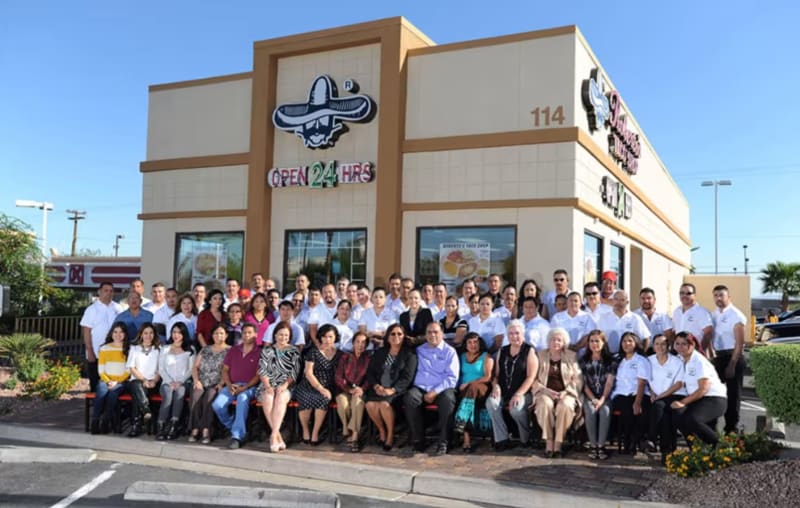
Roberto’s Taco Shop began with Roberto and Dolores Robledo, who started in the food business by making and selling tortillas. According to Roberto’s own history, the couple opened a tortilla factory in San Ysidro in 1964 before expanding into what the company describes as San Diego’s first traditional-style taco shop.
That detail matters because San Ysidro is not just a dot on the map. It is one of San Diego’s border communities, shaped by daily cross-border life, working families, and the constant movement of people, food, language, and habits between San Diego and Tijuana. The taco shop template that grew from there was not “Mexican food for tourists.” It was fast, affordable, practical food for people who needed it to fit real life.
One of the best parts of the Roberto’s story is how ordinary the beginning sounds. Before there was a chain, before there were copycats, and before “-berto’s” became its own shorthand, there was a family making tortillas and responding to what customers wanted. Some accounts trace the move toward a fuller restaurant menu to customers asking for more than tortillas — rice, beans, burritos, and eventually the kind of complete taco shop menu San Diegans now recognize immediately.
Reynaldo Robledo, one of Roberto and Dolores Robledo’s children, has helped tell that story publicly in recent years. In NBC News’ 2022 piece on Roberto’s, the chain is framed not only as a restaurant success story, but as a family-run business that grew into a Southwest phenomenon. That makes the Roberto’s story feel less like a simple brand origin and more like a family tree that turned into a regional food language.
What Roberto’s Standardized
Roberto’s did not invent every item San Diegans associate with taco shops. The California burrito’s exact origin is famously debated, and that deserves its own article. But Roberto’s helped standardize the format: the menu, the speed, the late-night usefulness, the rolled tacos with guacamole, the combo plates, the breakfast burritos, and the sense that a good taco shop should be there when you need it.
The classic San Diego taco shop became recognizable by a few things:
- A menu board with burritos, tacos, tostadas, enchiladas, rolled tacos, breakfast burritos, combo plates, and sides
- Carne asada as a central ingredient, not a specialty add-on
- Salsa that matters enough to change the whole meal
- Flour tortillas that carry real weight
- Food built for takeout, car eating, lunch breaks, and post-beach hunger
- Prices that historically made it part of everyday life, not a special occasion
The food itself is important, obviously. But the bigger Roberto’s Effect is that San Diego learned a template. Once you know it, you can spot it anywhere.
The Rise of the “-berto’s” Universe
Eventually, Roberto’s became more than a restaurant name. It became a pattern people recognized. Across San Diego County and beyond, names like Alberto’s, Filiberto’s, Aliberto’s, and other “-berto’s” variations started to feel like part of the same extended taco shop universe.
NBC News described the spread of Roberto’s and its many “-berto’s” variations as a Southwest phenomenon rooted in one Mexican immigrant family’s business model. That detail is important because it makes the “-berto’s” world feel less like copycat branding and more like a restaurant family tree.
Some shops were directly connected by family. Some came from former employees, friends, or people from the same home region. Others followed a naming style customers already associated with fast, filling Mexican food. But the effect was the same: a whole regional category formed around a familiar rhythm — burritos, rolled tacos, combo plates, salsa cups, late hours, and no-frills service.
This is why the names can feel confusing from the outside but totally normal to people who grew up with them. Roberto’s, Alberto’s, Filiberto’s, Hilberto’s, Raliberto’s — at some point, the suffix became a signal. It told you what kind of place you were probably walking into before you even read the menu.
From San Diego to the Southwest
The Roberto’s Effect did not stay in San Diego. It moved through the Southwest, especially Nevada and Arizona, and helped create a recognizable style of Mexican fast food that former San Diegans can often spot before they even taste it.
In Las Vegas, Roberto’s became its own late-night institution. In Arizona, Filiberto’s and other “-berto’s” restaurants helped make the format familiar to a different desert city. In Southern California, the template continued to show up in neighborhood taco shops from National City to Clairemont, from Chula Vista to Oceanside, and everywhere in between.
That spread matters because San Diego taco shop food travels differently than other regional foods. It is not just one dish. It is a system.
A former San Diegan can walk into a shop hundreds of miles away and start checking the signs:
Are there rolled tacos with guacamole? Is there a carne asada burrito without rice taking over the whole thing? Are the breakfast burritos built like meals, not snacks? Do the fries in the carne asada fries have a chance, or are they doomed from the start? Is the salsa good enough to remember?
When those answers line up, it feels less like finding a random restaurant and more like finding a little piece of home.
Why This Style Travels So Well
San Diego-style taco shop food travels because it solves a very specific kind of homesickness.
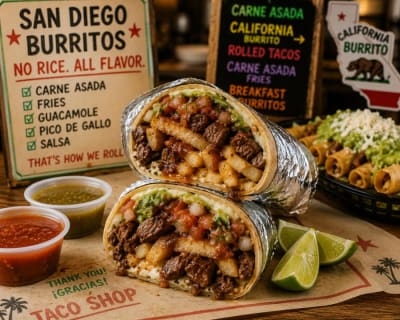
A California burrito is not subtle. Carne asada fries are not delicate. Rolled tacos with guacamole are not trying to win a plating award. But they are incredibly specific. They tell you where someone learned to eat.
That is why former San Diegans get so excited when they find a shop outside California that gets the basics right. It is not enough for a menu to say “California burrito.” The fries need to hold up. The carne asada needs to taste grilled, not steamed. The tortilla needs to be soft but strong. The salsa cannot feel like an afterthought.
The “-berto’s” model also works because it is casual by design. These places are built around usefulness. They are for lunch breaks, late nights, quick dinners, beach days, long drives, and the kind of hunger where you do not want a concept. You want a burrito.
That everyday usefulness is part of why the format became so durable. A taco shop does not have to be fancy to become beloved. It has to be reliable.
San Diego Taco Shops Are Not L.A. Taquerías
This is where regional pride gets loud.
Los Angeles has one of the greatest taco scenes in the country. Nobody serious should argue otherwise. L.A. excels at regional Mexican food: Oaxacan restaurants, Sonoran-style flour tortillas, Jalisco-style birria, Sinaloan seafood, Tijuana-style street tacos, and more.
San Diego’s taco shop culture is different. It is less about one perfect taco and more about the full shop experience: burritos, rolled tacos, carne asada fries, salsa, combos, late hours, and that unmistakable drive-thru or strip-mall rhythm.
That does not make one city “better.” It makes them different regional languages. L.A. often speaks in tacos. San Diego speaks in burritos, rolled tacos, fries, and salsa cups.
The Menu Items That Became the San Diego Accent
If the Roberto’s Effect gave San Diego a template, these are some of the words in the vocabulary.
Rolled tacos
Rolled tacos are one of the clearest San Diego taco shop signatures. Other places might say taquitos or flautas, but in San Diego, “rolled tacos with guac and cheese” is its own sentence.
The version many San Diegans grew up with is simple: crisp fried rolled tacos, shredded cheese, guacamole, maybe lettuce depending on the shop, and salsa on the side. It is not complicated, but it is extremely easy to miss when you leave.
Carne asada burritos
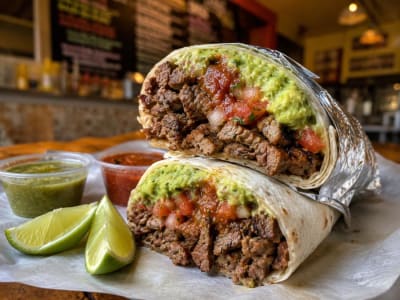
Before the California burrito became the internet-famous item, the carne asada burrito was already a foundation. Meat, salsa, guacamole or pico depending on the shop, and a tortilla that can handle the job. No rice-and-bean filler required unless that is the house style.
This is where San Diego burrito culture separates itself from Mission-style burritos. A San Diego carne asada burrito is usually more stripped down. The point is not to create a massive all-in-one rice-and-bean meal. The point is the meat, tortilla, salsa, and balance.
Breakfast burritos
The San Diego breakfast burrito deserves more respect. Eggs, potatoes, cheese, bacon, ham, sausage, chorizo, machaca — every shop has its own rhythm.
It may not get the same national attention as the California burrito, but for a lot of San Diegans, the breakfast burrito is the real everyday workhorse. It is morning food, hangover food, road food, and “I forgot to eat lunch” food.
Carne asada fries
Carne asada fries may be the most obvious San Diego export for people outside the region, but they also reveal whether a shop understands balance.
The fries cannot collapse. The guacamole cannot be watery. The cheese, sour cream, meat, and salsa need to work together instead of becoming a salty landslide. Great carne asada fries are not just “nachos with fries.” They are their own thing, and San Diegans know when they are wrong.
Why San Diegans Still Care
The reason people argue about Roberto’s, Alberto’s, Filiberto’s, Lolita’s, Santana’s, Nico’s, Cotixan, Vallarta Express, or their own neighborhood shop is not just because they want food rankings. It is because these places become attached to a time and place.
A taco shop might mean getting food after a high school football game in National City. It might mean a post-surf burrito near Pacific Beach. It might mean stopping in Mira Mesa after work, grabbing rolled tacos in North Park, or realizing years later that the thing you miss most about San Diego is not a beach view — it is a salsa bar.
That is why SanDiegoBurritos.com exists. The mission is not just to find “Mexican food.” It is to find the shops that speak this very specific San Diego language.
The Roberto’s Effect is the reason so many of us can walk into a taco shop we have never visited, scan the menu for five seconds, and know exactly what kind of place it is trying to be.
And when it is right — when the tortilla is warm, the fries are crisp, the carne asada has real char, and the salsa tastes like somebody cared — it feels less like discovering a restaurant and more like finding a piece of home.