# The California Burrito: San Diego's Perfectly Overstuffed Claim to Fame
Some foods simply belong to a city. Chicago has deep dish. Philadelphia has the cheesesteak. New York has the slice. San Diego has the California burrito.
The name can confuse outsiders, because a "California burrito" does not always mean the same thing everywhere. In some cities, it may describe a Mission-style burrito packed with rice, beans, salsa, lettuce, and whatever else fits inside the tortilla. But in San Diego, the definition is much more specific:
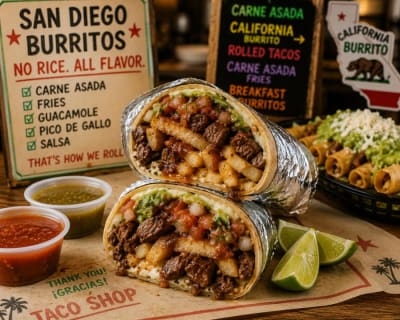
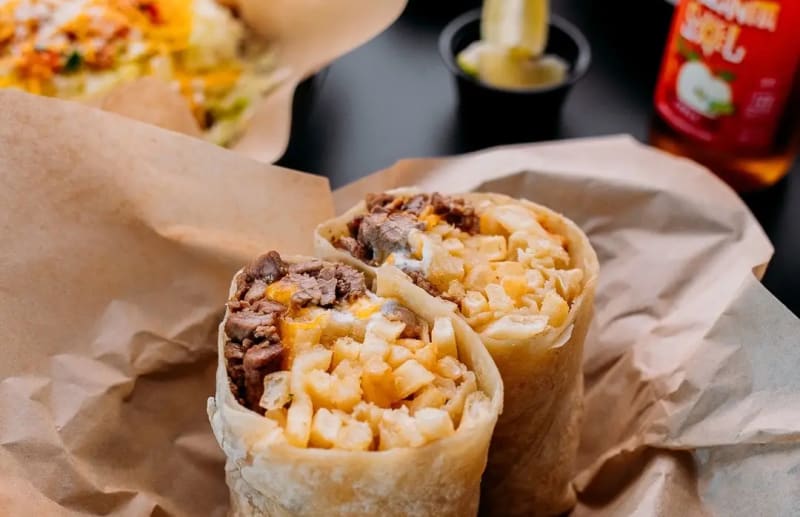
> A flour tortilla wrapped around carne asada, cheese, and french fries.
Depending on the taco shop, you may also find guacamole, sour cream, pico de gallo, or salsa, but the heart of the thing is beef, cheese, tortilla, and fries.
That combination sounds obvious now. Of course hot, salty potatoes belong with grilled beef. Of course fries make a burrito more satisfying. Of course a dish built for surfers, students, night-shift workers, bar crowds, and hungry locals would become a San Diego icon. But at some point, somebody had to look at a carne asada burrito and think: this needs fries.
---
A Burrito With a Foggy Birth Certificate
The California burrito's origin story is not clean. There is no official first receipt, no city plaque, no single framed photo of the first one ever sold. Like many great regional foods, it seems to have come from real life: hungry customers, family-run taco shops, late-night cravings, menu experiments, and word-of-mouth.
That makes the question of "who invented it?" both fun and nearly impossible to settle. San Diego Magazine's article points to a few key names that come up again and again: Lolita's, Santana's, and Roberto's. The exact answer depends on who you ask, which neighborhood they grew up in, and how much they are willing to argue about burritos.
One version points to Lolita's Mexican Food, especially the Bonita location, sometime in the 1980s. According to José Robledo of Roberto's, the idea may have started when a regular customer brought in his own french fries, ordered a carne asada burrito, opened it up, added the fries, and rolled it back together. A worker noticed, tried the combination, and realized the customer might be onto something. That is exactly the kind of story that makes food history feel believable. It is not a corporate brainstorm. It is a hungry person improving lunch.
Another claim comes from Santana's Mexican Grill, which has long connected itself to the dish with the phrase "home of the California burrito." In that version, the invention is tied to El Cajon in the late 1980s, with the same basic move: take a carne asada burrito and add fries. Whether the first official California burrito came from Lolita's, Santana's, Roberto's, or an unnamed taco shop regular who deserves more credit than history gives him, the important part is that the idea caught fire in San Diego.
The uncertainty is part of the charm. The California burrito does not feel like something invented in a test kitchen. It feels like something discovered in the wild.
Why Fries Changed Everything
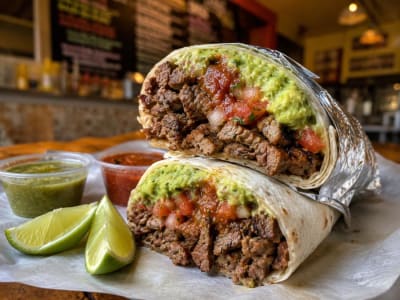
A carne asada burrito was already a San Diego classic. It did not need saving. A good one is simple and powerful: warm tortilla, grilled marinated beef, salsa, maybe guacamole, maybe pico de gallo. It is direct, messy, satisfying, and deeply tied to the city's taco shop culture.
So why did fries make it better? Texture, weight, and attitude.
Fries bring crunch when they are fresh, softness when they steam inside the tortilla, and salt in every bite. They soak up meat juices, salsa, and melted cheese. They turn the burrito from a meal into an event. Instead of a burrito that is mostly meat and tortilla, the California burrito has a comfort-food layer built in. It is part carne asada burrito, part loaded fries, part hangover cure, and part edible brick.
Rice can bulk up a burrito, but fries do something else. Rice disappears into the background. Fries announce themselves. They carry flavor, hold structure, and give the burrito its San Diego personality. A California burrito without fries is not a California burrito. It is just a carne asada burrito standing near a potato.
That is also why people get loyal about their favorite shop. Small differences matter:
- Are the fries crispy or limp?
- Is the carne asada chopped fine or left in bigger pieces?
- Is the cheese fully melted?
- Is there guacamole? Sour cream? Pico?
- Is the tortilla strong enough to survive the final bites?
Every taco shop answers those questions differently, and every regular has an opinion.
The Taco Shop World That Made It Possible
To understand the California burrito, you have to understand the world that produced it. This is not a white-tablecloth dish. It belongs to bright menu boards, salsa bars, styrofoam cups, plastic baskets, drive-thru windows, and foil-wrapped meals handed across counters at all hours.
San Diego's taco shop culture is its own language. The city is full of small Mexican restaurants and drive-thru spots where the names often end in "-berto's" or sound like they might. Roberto's, Alberto's, Filiberto's, Rigoberto's, Adalberto's — some are related, some are not, and many have loyal followings. The important thing is the format: fast, filling, affordable Mexican food built for everyday life.
That environment was perfect for the California burrito. Taco shops already had the ingredients on hand:
- Carne asada — already grilling
- Flour tortillas — already stacked
- Cheese — already shredded
- Fries — already there, because combo plates and side orders were part of the menu
The leap from "fries on the side" to "fries inside" was small, but the effect was huge.
This is how regional food often evolves. Somebody modifies an order. A cook remembers it. A few regulars ask for the same thing. It becomes an off-menu trick. Then it becomes a whispered recommendation. Eventually it appears on the board. By the time anyone tries to trace its origin, half the city feels like it has always been there.
Lolita's, Santana's, and Roberto's
The debate over who truly created the California burrito is less about courtroom-level proof and more about cultural memory.
Lolita's has a compelling story because it includes the kind of customer improvisation that feels real. A regular bringing his own fries into a shop and rebuilding his burrito is oddly specific, and oddly perfect. It also explains why the dish could have existed informally before it appeared as an official menu item. People often invent things before businesses name them.
Santana's has its own strong claim, especially because it publicly embraced the California burrito identity. A restaurant calling itself the home of a famous regional food matters, even if food history is rarely clean enough to prove. Sometimes the place that names, sells, and promotes a dish becomes just as important as the person who first assembled it.
Roberto's matters because of reach. Even if Roberto's was not the single point of invention, it helped spread the California burrito through taco shop culture and beyond. Popularization is its own kind of creation. A dish can be born in one place and become famous because another place serves it consistently, teaches customers to order it, and makes it part of the everyday menu.
The fairest answer may be this: the California burrito came from San Diego's taco shop ecosystem, with Lolita's and Santana's as leading origin claimants and Roberto's as one of the key forces that helped make it legendary.
Why It Is Not a Mission Burrito
Part of the confusion around the California burrito comes from the fact that California has more than one famous burrito tradition. San Francisco has the Mission burrito, a giant foil-wrapped style associated with the Mission District. That burrito often includes rice, beans, meat, salsa, sour cream, guacamole, and other fillings. It became nationally familiar partly because chains and fast-casual restaurants helped spread that format across the country.
San Diego's California burrito is different. It is not trying to be a full pantry wrapped in a tortilla. It is built around a focused idea: carne asada and fries.
That difference matters. For many San Diegans, rice in a burrito is controversial, especially when it shows up where fries should be. Rice has its place, but not here. The California burrito is not about filler. It is about the specific magic that happens when grilled beef and french fries share the same tortilla.
This is why San Diegans can get territorial about the name. If a menu outside Southern California says "California burrito" and hands over something with rice, beans, lettuce, and no fries, it feels like a minor betrayal. It may be a perfectly good burrito, but it is not the San Diego version.
A Dish Built for San Diego
The California burrito fits San Diego because San Diego is a city of movement. People eat it after the beach, after work, after class, after the bars, before a long drive, during a lunch break, or whenever hunger gets serious. It is portable, filling, and casual. It does not ask for formality. It asks only whether you want salsa.
It also reflects the city's border influence without pretending to be traditional Mexican cuisine in a narrow sense. The California burrito is Mexican-American, San Diegan, and proudly local. It is a product of proximity, adaptation, appetite, and everyday restaurants feeding everyday people.
The Name Still Belongs to San Diego
There is a strong argument that "California burrito" is too broad. California is huge, and San Diego did the work. San Diego built the taco shop culture that made it possible. San Diego defended the fries. San Diego knows the difference between this and a rice-filled Mission burrito. "San Diego burrito" might be more accurate, but food names are stubborn. The important thing is that locals know what the name means: carne asada and fries in a tortilla, no explanation needed.
The Legacy
The California burrito may never have a single universally accepted inventor, and honestly, that feels right. It belongs to more than one family, more than one shop, and more than one neighborhood memory. It belongs to:
- the customer who first put fries in his burrito
- the counter worker who noticed
- the cooks who made it repeatable
- the taco shops that put it on the menu
- the people who ordered it at midnight and told their friends the next day
What started as a simple modification became one of San Diego's defining foods. It gave the city a burrito that is instantly recognizable, deeply satisfying, and just controversial enough to inspire debate. It also gave San Diego something rare: a dish that feels both obvious and original. After you eat one, you wonder why every burrito city did not think of it first.
But they did not. San Diego did.
So the next time someone asks who invented the California burrito, the safest answer is this: San Diego invented it. Lolita's may have been there at the beginning. Santana's may have a rightful claim. Roberto's helped make it famous. The full truth may be wrapped in foil and lost to time. But the result is undeniable.
The California burrito is San Diego in edible form: border-town flavor, beach-town appetite, late-night practicality, and just enough stubborn local pride to insist that fries absolutely belong inside the tortilla.